Starless 16 and below are compatible with your current dwarf data, you can go back and forth from the official image to Starless with the normal update procedure.
There is no technical need to backup your data, but I strongly advice to do a full backup anyway.
Be aware that Tone3K integration and filesystem subfolder are not yet released. From my tests filesystem subfolder interfere with plugin presets: I had to select and save again each preset, but I don’t really know why.
First, thanks for Starless — I’ve been running it on my Dwarf and the extra screen features are exactly what I was missing.
I write my own LV2 plugins for the Dwarf (looper, sequencer, tuner) and I keep hitting the same wall: the HMI API gives me labels, values and indicators, but nothing to draw with. I wanted to ask whether you think two things would be feasible.
The first one looks small. I had a plugin sweep every byte from 1 to 255 through set_label to see what the font could render, and everything above 126 came out blank. Looking at fonts.h in your controller fork, that makes sense: Terminal5x7 declares first char 0x20 and 0x5F characters, so anything past 126 is skipped by the draw loop. What caught my eye is that the 26 lowercase slots hold copies of the uppercase glyphs, with the real lowercase bitmaps sitting right next to them, commented out. So there seem to be 26 addressable slots that carry no unique information today. Replacing a few of them with custom glyphs — say an 8-step vertical bar for gauges — would be pure table data, no header change, no code change, and a plugin could reach them just by sending lowercase letters. Does that seem safe to you, or is something else relying on those slots?
The second one is bigger. The stock firmware already registers glcd_draw, glcd_text and glcd_dialog in protocol.c, and they’re reachable from the system serial link as well as the web UI one. I tried an experiment: I patched mod-system-control to forward raw glcd_draw commands from a plugin. It worked — I got bitmaps on screen with no firmware change at all, and the display refreshed on its own. But it was not stable. Anything close to 1 KB desynchronised the link, and the daemon eventually segfaulted in its own reader, which left mod-host writing into an orphaned shared memory. My takeaway is that the transport was simply never meant to carry a second writer, and that a real drawing path would have to be designed at both ends — a proper framed command with a length and an ack, plus some arbitration so a bitmap can’t cut into a label update. Is that something you’ve ever considered for Starless, or does it look like more trouble than it’s worth to you?
I’m happy to do legwork and testing on a spare Dwarf either way. Thanks for everything you’ve built.
I’ve been thinking about your font proposal, and I see a couple of critical points.
The font modifications themselves are easy to implement, but:
With the new font, your plugin will only work on Starless, of course. Until now, Starless and the official image have remained compatible.
How could you support both firmware versions? Is there any runtime check you could use to detect which firmware is running?
If not, you wouldn’t be able to distribute plugins using the new font through the official store.
Regarding glcd_draw, I think it’s a great proposal. However, I’ve checked the serial code several times and it’s very fragile. I can try to fix it or implement a workaround, but I can’t promise that I’ll be successful.
Yes, absolutely — I’m happy to reflash the HMI controller and test whatever you want to throw at me. Send builds whenever they’re ready and I’ll run them.
On detecting which firmware is running: I don’t think a plugin can ask the firmware anything, since the HMI API is one-way from the plugin’s side. But it doesn’t have to be a protocol question at all — a plugin can just read a file at instantiate() time. If Starless dropped a marker file somewhere stable, say /etc/starless-version containing the build tag, any plugin could check for it once at startup and pick its rendering accordingly. Nothing to change in the protocol, no runtime cost after the first read, and it would work for any future Starless-only feature, not just fonts. Would that be acceptable to you?
There’s also a natural fallback that makes this less risky than it looks. On the official firmware, the lowercase slots hold copies of the uppercase glyphs, so a plugin that sends lowercase characters gets letters instead of custom glyphs. Ugly, but it degrades rather than breaking, and there’s no crash or undefined behaviour. So a store plugin could ship with an ASCII fallback and light up properly on Starless. That said, I’d rather follow your judgement here — if you’d prefer to keep Starless and the official image compatible, I’m fine treating the font as a personal build for my own plugins and not something for the store.
On glcd_draw and the fragile serial code — I agree completely, and I may have one useful data point from breaking it myself. When I fed it large messages, the daemon segfaulted, and I think it’s in serial_rw.c: on the error paths it evaluates buf[reading_offset + ret - 1] to decide which error to return, but ret can be zero or a negative error code there, so the index goes negative and reads outside the 255-byte buffer. Guarding those three sites with ret > 0 stopped it from crashing in my tests, though of course it doesn’t fix the desync that got it there in the first place. The threshold I measured was interesting too: full-frame messages of about 1 KB desynchronised the link almost immediately, while 8-row strips of roughly 270 bytes survived far longer. Reading the code, it looked to me like the drain only happens in the idle gaps of the reader loop, which would cap throughput regardless of how fast the writer pushes.
Happy to send you my patch and my test tools if any of it is useful, though it’s experimental and I wouldn’t defend the design. Thanks a lot for looking into this.
I like this simple solution, and perhaps what we already have is sufficient. Take a look at:
/etc/mod-release/release
You’ll find the release version for Starless there. It ends with stls. For example, this is the content of the file in the latest release:
v1.13.5.3315-stls16
I don’t like the idea of changing the lowercase glyphs: a plugin that sends lowercase letters after the change would start displaying custom glyphs instead.
What about adding some more glyphs instead? What do you need?
This is my proposal for adding 16 new graphic glyphs:
A question, since most active development is going on here. I had some issues with the MOD UI for a while now and thought, why not fix them myself. So I made a few changes to it which I think should make others happy as well.
Most are related to me needing more pedalboard real-estate (I need a very big pedal)
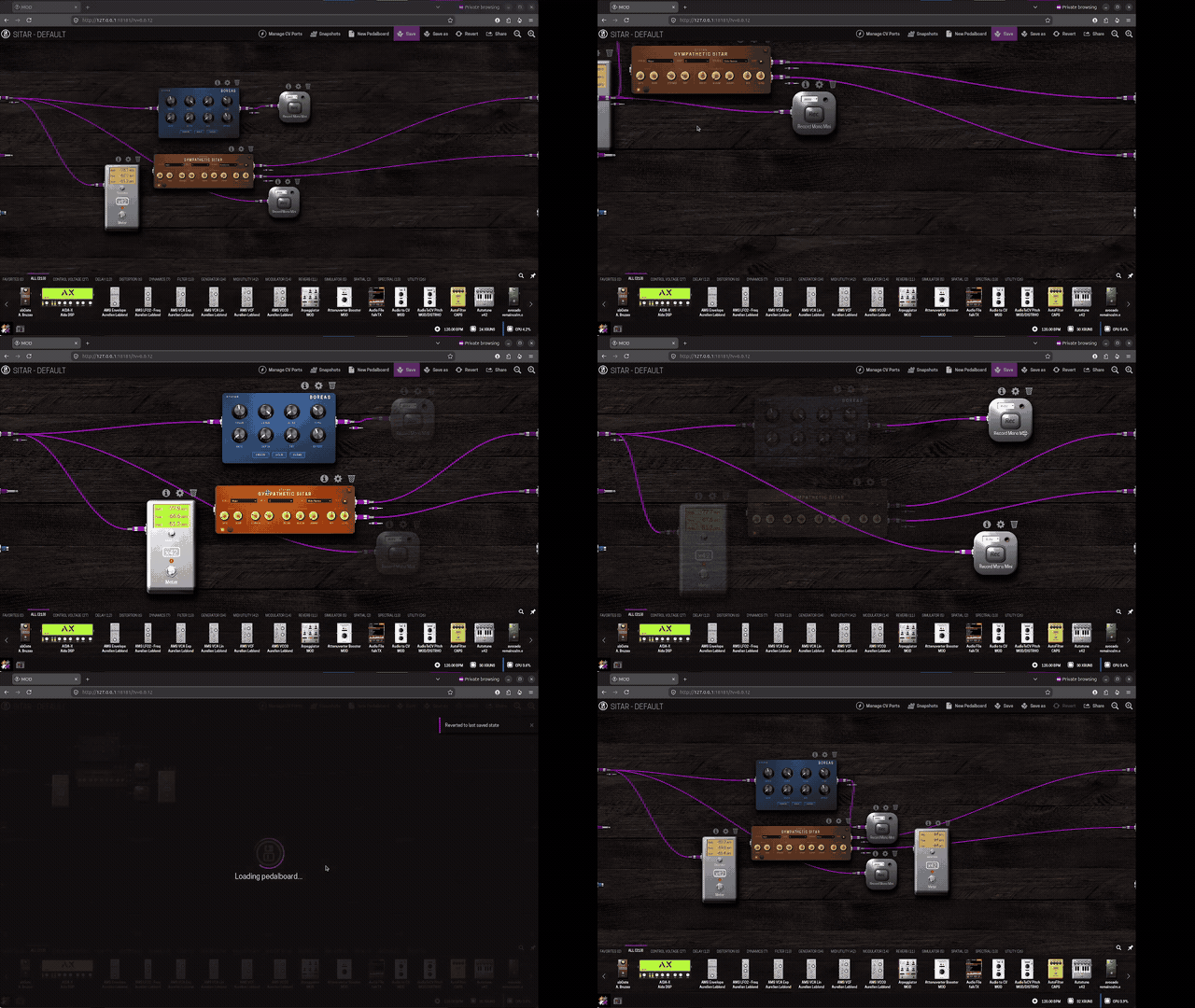
The mouse wheel now zooms in and out. The feature existed in the past but there was an issue that the mouse wheel already controls dials when you hover over them, so I made it so it now only zooms in/out if your mouse starts over the background.
You can now marquee-select multiple plugins with shift+click and move them around all together
Canvas total size quadrupled (twice the width, twice the height)
The input/output jacks are anchored to the screen edges not the canvas, so panning will also move the cables around a bit
A reset button top right which reloads your pedalboard because I end up refreshing the page all the time which is more costly since it reloads all plugin icons etc
Let me know if you would be open to additions like these to Starless
I like all your changes. The mouse wheel support was already on my TODO list, so I’m very happy to include it in Starless.
Could I ask you to elaborate a bit more on what the Reset button is meant to solve? I understand the speed improvement it provides, but I’m curious about the use case: why would someone need to reload the pedalboard frequently?
Feel free to open pull requests against starless/devel. If possible, one pull request per feature would make the review process much easier for me.
For me the reset is useful because I play around with parameters a bit in the UI but don’t want to save them after all and overwrite my pedalboard. But then I remember that I wanted to add this new plugin, so now I need to refresh to be sure there are no unsaved changes on my other plugins before I continue work. Maybe there is some better way to do this which I don’t know of?
Sure I can split it into pieces! I am checking one more thing now because the extended canvas was a weird idea since in reality MOD UI has an infinite canvas (I think?), it just grows in a very difficult way so I’ll try to figure out something better.
OK, so it’s basically a reload pedalboard function. Maybe we should hide it behind the Developer option in the Advanced settings. Let me think about it a bit more.
Yes, I think so. To make it grow, you just need to place a plugin a bit beyond the current edge. I also think it’s not very user-friendly in its current form, though, and the canvas should probably expand more.
Meanwhile, if you want, just prepare the other features.
I have always thought some sort of “Container”/“Sub Patch” functionality could be quite neat, I’m guessing that it would be quite a bit of work though.
I’ve also added 16 new characters to the font. They’re provisional for now and still need some refinement. You can print them using the hex codes from \x7F to \x8E.
Of course, we can decide together which glyphs to include and refine their design.
Here are the current glyph definitions:
If you want, you can track the wip/drawing branch for our experiments.
This is actually really cool and somehow goes together with something I’ve talked recently with @gianfranco.
Would you be up to release this OS image just as you have it?
Of course if you are open to it @AndreaDelSignore or anyone else could add it to other images. Eventually at some point some of the features could make it to the “official” MOD OS. Something similar to what happens with Debian.
Exactly what I discussed a little bit with @gianfranco was that we should give more space and incentivise users to “adapt” and share their own version of the MOD OS. So sort of have “more Starless”, bringing it to a point just like the plugins are currently. Which could then benefit the entire platform.
What do you say about sharing your version just as it is?
Yes, it does. But I can see some point one what you are trying to do.
Exactly what I feel.
EDIT: I just created a new subcategory here in the forum where I moved this thread into. @StefanD if you are up to share your image for the MOD OS as it is, just create a new thread in: Alternative MOD OS versions - MOD Audio Forum
hi @jon ! I thought about it but on the other hand I do want to keep also the features of Starless which I like so I think diverging into two separate OS images would cause more trouble (unless I build it as a very clean fork on top of Starless?).
I’m not entirely sure what the best way to go would be. If I keep my own image I need to sync Starless changes into it and if then Starless like my features they sync them back, so it complicates things a bit, although it does give me total freedom to do what I want, so I’ll consider it.
If you eventually want to merge any of these features into the official MOD ecosystem it will be pretty easy and I could help with that.
I’d be happy to include his work in Starless. I’m checking the PR right now.
@StefanD, if you want to release your own image as well, feel free to use my script. I’m also happy to answer any questions if you need help.
That’s great! Could you also rename this thread to “Starless by aLabs – Development”?
I’d like to keep the development discussions separate from the official release announcements. I’ll create a new thread Starless by aLabs – Releases dedicated to release announcements starting with the next version.
@StefanD, I was thinking the same. For now, we can simply try to collaborate—we have the same goal: making the UI more user-friendly.
A separate Dwarf image could become useful if the UI or some other features diverge enough to make it worthwhile. In the meantime, we can help each other with development and, most importantly, testing.
@AndreaDelSignore I kind of thought to not spam here anymore with UI suggestions to not take over the Starless thread so I just posted my next idea here for brainstorming Stereo cables
That could be an option. Anyway, @AndreaDelSignore can always merge your “new features” or merge just some. Who manages his MOD OS version should be him. I guess he doesn’t even need to ask you for permission, because you are the one requesting it
And your origin fork, imo is also up to you.
That’s really kind of you. Eventually, at some point, we may talk about that
That sounds great @AndreaDelSignore! And please don’t take me the wrong way; the goal is not to create some sort of competition, but rather to provide different perspectives.
Maybe you don’t feel that X feature is worth including in your version. And maybe another developer feels everything is great about yours, but has a different approach to tackle something that you have.
Done
It makes perfect sense. The discussion area is exactly where we can have conversations like this (about merging features that someone else created, reporting bugs, etc.)
Of course that’s totally valid! If you feel like doing it, share the version that you have right now @StefanD and eventually you officialize a merge with Starless. Not sure if all features will make it exactly as they are, but it may be worth creating a development chronology.
Don’t worry, I agree with you on this point. But at the moment, I think that since there are only a few of us working on MOD, it’s more important to work together and avoid being too fragmented.
We can always brainstorm ideas together on the forum and then decide where each feature belongs.
I also think that too much fragmentation isn’t a good thing for end users, as @StefanD pointed out.
At least until MOD starts releasing updates again.
Yes. Most important is that there’s some sort of version control.
That’s something where MOD always excelled. Then, on passing it to implementation, not really, but what you have been doing shows us that with the community together also on this, that difficulty can be overcome.