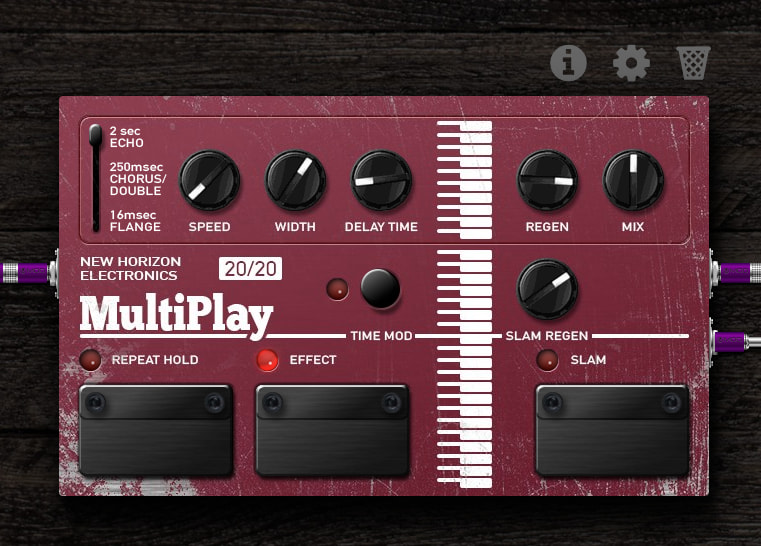
One more for the weekend!
This is a faithful-ish recreation of the late 80’s early 90’s DigiTech PDS 20/20 Multi-Play that is really an 8-bit sampler pretending to be a delay. Unlike most delays, that move a tap along a buffer, the MultiPlay instead changes how fast a fixed loop of memory is clocked. That one design choice explains almost everything odd about it: sweeps bend pitch like tape, a held loop speeds up and slows down, and long delays get darker and grittier.
Sound characteristics
The 20/20 sounds lo-fi but lush: grainy, slightly breathy repeats that bend in pitch whenever anything moves. Modulation settings are “a sort of chorus/flanger” that “doesn’t quite sound like either”, with an unmistakable 80s vibe.
- Grain that follows the note. leaves a fizz riding on the echoes. Quiet tails sound grittier than loud ones.
- Breathing. Envelope pumps slightly on attacks and decays, the same family of sound as old analog-companded delays.
- Pitch-bending sweeps. Delay Time changes the sample clock, so any knob move or LFO sweep is a Doppler warble, not a smooth tap glide. Fast moves give tape-like dives and squeals.
- Darker, dirtier repeats. Each pass goes back through the filters, so repeats lose top and gain grit.
- Long delays get grimier. At the 2 s end the clock drops to about 33 kHz.
- Flange and chorus with an edge. On the 16 ms range it’s a sharp, jet-like flanger; on 250 ms a wobbly, slightly seasick chorus/double.
- Wide stereo. The two outputs carry the echoes in opposite polarity, so in stereo they spread outside the speakers. Summed to mono they cancel.
It rewards ambient, noise and experimental playing more than tidy rhythm delay.
What makes it unique
The pedal’s best sounds come from treating Hold and Delay Time as a sampler and a varispeed.
- Bass grind. Catch a loop on Hold at a short delay, then turn Delay Time up: the loop drops in pitch and slows down into a grinding, crunching low end.
- Tape-stop and scratch. On Hold, sweep Delay Time quickly for dives and rises, or rock it back and forth for a scratch-like effect.
- Sound-on-sound. Hold a loop, release Hold to play a new part with Regen up, then hold again. The new layer joins the loop and the older layers fade each pass.
- LFO-driven glitch. Hold a loop and raise Width and Speed: the LFO warps the loop’s pitch and speed on its own.
- Self-oscillation. With Regen at its trimmed maximum, or with the Regen trim turned up, the loop runs away into screaming, pitch-sweepable feedback.
- Ghost loop. Hold a loop, then bypass. It keeps running silently and is back the moment you switch the effect on.
My Modifications
I still have my MultiPlay, and I’ve included my personal mods in the digital version.
- Slam Button. An extra knob and momentary footswitch to set a second “regen” to self oscillate. The ramp time between the two can be set in the settings. Great for live noise washes that build and decay with ease.
- Time mod. It’s no secret that the trimpot inside could stretch out the clock (max 10 seconds of extremely noisy delay), but I’ve always had it at about 4 seconds, which i included in this one.
Notable users
Jonathan Hischke Hella, Dot Hacker (bass)
Juan Alderete Racer X, The Mars Volta (bass)
Nathan Latona Tera Melos (bass)
Masahiko Ohno Solmania (Japanese noise)
Demo and Install
Sounds sample of some of the “sample and hold” + the lfo driving the sample time weirdness.
(much more sounds to be had, and goes great with the Taj Mahal Reverb heard at the very end!)
MultiPlay 2020 noodling
Link to MOD Cloud builder:

