First time posting here and my first plugin. I’ve been playing around with Plug Data and Daisy Seeds for a while and recently learned of MOD Desktop, MOD Dwarf and the PiStomp and decided to take a crack at that.
The effect is based on Italian made magnetic drum and tape delays from the late 50’s/early 60’s and were sold under the badges of Vox, Meazzi, Framez and Jennings. The most famous user (in the UK, Europe anyhow) was Hank Marvin of the Shadows, though he is nearly totally unknown here in the States.
I believe the original idea behind these devices was to make a portable reverb for vocalists performing live but guitarists took the idiosyncrasies of the things and ran with them. Using the multiple heads to make all sorts of skipping rhythms and such.
I included a version compiled on RaspberryPi 5 (PiStomp), a version for Windows x86 MOD Desktop and an attempted compile of an x86 Linux version for MOD Desktop, but I haven’t tested that one yet.
I’ll work on a better way to host the files and information on the history and settings of each of the modeled units in the near-ish future.
Anyhow, let me know what you think, or if it even works for you. Thanks for your time.
second; can you make a sound or video demo? The description sounds like I might use it but for less techie people like me it’s a hassle to get it tested.
Many developers in this and other communities assume everybody is comfortable with the less ‘out of the box"’ setups but it helps with selling to everybody if there is some very accessible demo material.
In AIDA (marketing) terms it is to get people from “Interest” stage to “Desire”.
Your GUI and the word “reverb” already got my “Attention”… If you get get me to Desire with less hassle, the chances of 'Action" improve.
A very elaborate way to ask for an easy way for me to check some of its features but if will help you get the word out anyway ^^
Thank you as well LievenDV. I had almost as much fun making the GUI and the effect itself!
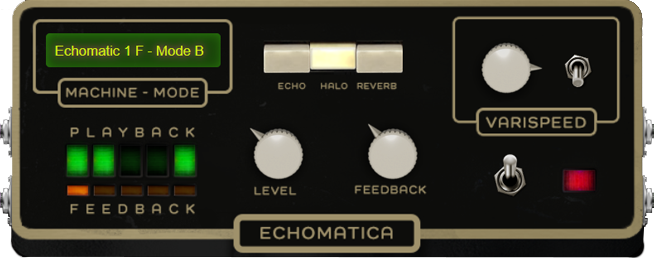
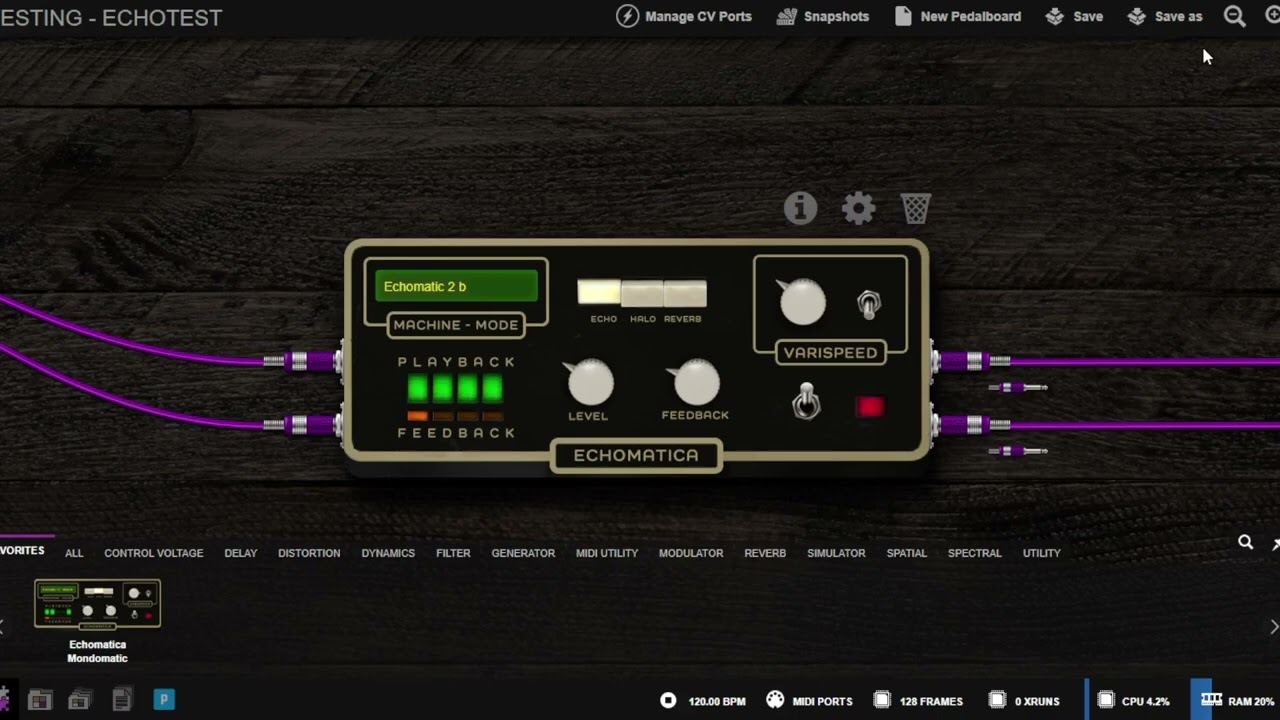
The “Echo/Halo/Reverb” buttons on the original machines do a little less than modern people would expect. From what I understand, Repeat mode was just one set of echoes with no feedback, Echo was feedback from one head (usually the longest delay head). Halo and Reverb were different combinations of playback and feedback heads to make it sound less like a bunch of echoes and slightly more like reverberation. But in practice, the echoes are still too distinct to be truly called reverb.
In this plugin, however, Echo = mono delay, Halo = stereo modulation added to the delays, Reverb = stereo mod and 3x the feedback.
You are absolutely right that demos are needed. I was planning on an elaborate video for youtube/insta/etc but I haven’t figured out what to say/show yet.
In the meantime, here is a clip of me briefly noodling around with some old songs and strumming chords to help get the general idea.
That is good question of whether any of the linked versions will work on the MOD Dwarf. I really don’t know what to compile for that. The ARM64 version was compiled on a Raspberry Pi 5. No idea if that is close enough!
The Cloud Builder appears to only work connected MOD devices. I was hoping it would output a compiled .so file or whatever is appropriate, but that doesn’t seem to be the intention of that service.
The compiled versions won’t work on MOD Dwarf or any MOD device unfortunately. And the cloud builder does indeed only work when you have a MOD device connected. But another option to get MOD builds is using mod-plugin-builder: GitHub - mod-audio/mod-plugin-builder: MOD Plugin Builder · GitHub .
Is the code of this project public? If so, I could maybe help with compiling via the cloud builder.
That’s so cool about Apache and your formative guitar years, so to speak. Growing up in the States it was The Ventures, The Cramps and Cocteau Twins for me. When the Beatles Anthology first came out I saw a clip of these four odd-dudes in matching outfits doing a dance step to a mysterious instrumental. It was the Shadows doing FBI and I had to find out what that was all about.
Later on I ran into a guy forming a Shadows tribute-act with his father. His dad toured in a band in Croatia in the 60’s so it was like this ultimate father-son bonding project and they needed a bass player. They knew of my old Surf/Go-Go band and asked if I would learn a shit-load of instrumentals that I’ve never heard before that all seemed to be in the Key of A, and go perform them all to a hall full of Shadows fans. Sure, how could that go right?
At the time we were the only Shadows tribute act in the US that we knew of. The people from the UK were baffled by our existence. But I got to meet Bruce Welsh, Brian Locking and play Hank’s original Strat.
So other than me totally biffing several songs in front of the some of the original band members, it was a pretty cool experience.
Hey guys! Although the talk is great and @LievenDV, I guess this important question from @DaveM got lost @MondoJim, so I’m bringing it again to the top.
Sorry…I don’t want to be a D***, so keep the cool conversation. I’m also learning interesting stuff by reading it
@MondoJim I just tried to compile it, but I get an error saying:
Don’t know how to parse object “expr”. Is it an object supported by Heavy? Is it an abstraction? Have the search paths been correctly configured?
So it looks like your PureData patch uses objects incompatible with the Heavy compiler. In this case expr. I can try again if you send me a fixed patch.
What he said! I used Plug Data/Heavy Compiler to make the Windows and Linux versions so I know the patch works.
Eager to try it again when the cloud builder gets an update. Thanks guys.
And @dreamer thank you especially for the work you do on Heavy. You’ve enabled all sorts of fun projects on the Daisy and other platforms. I hope I can get this one to work on the MOD hardware at some point.
Downloads and additional details on the delay modes in the link.
Patch Notes for 1.2
UI Changes:
Feedback Mode lists actual function (Fdbck x1, Stereo Modulation, etc) instead of arbitrary titles like Echo and Halo, etc.
Knobs now correctly rotate on their center axis instead in an eccentric orbit…oops.
Knob color corrected to match buttons.
Plugin Changes:
Smoothed the response of the Varispeed control to prevent jumps in pitch when using external controls like digital potentiometers. Has the added benefit of simulating the inertia of a rotating drum.